


About Alex
designer | animator
https://alexalexmoy.com/
Current city: New York
Other cities: Chicago
designer | animator
 
Posted by Alex Moy
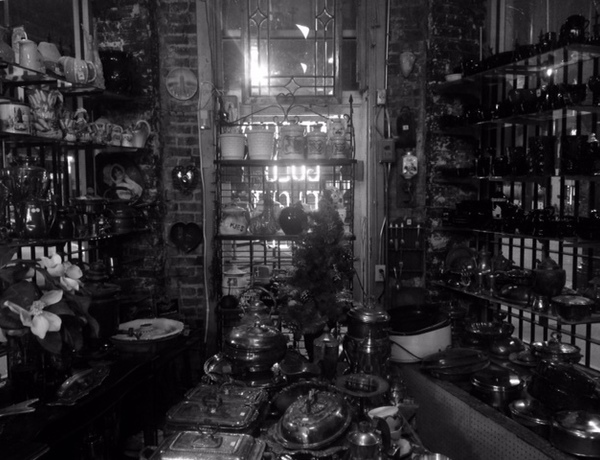
Lost Eras has easily become one of my favorite shops to explore; hidden just outside of Chicago, it stretches far and narrow, crowded with lost treasures. Walking through it, it's hard not to begin imagining the stories of the objects that turn up in its walls, and the people that once held them. Not to mention the building itself is a piece of history, as in the 1920's it was home of the night club the "Club Detour" which had many artists play in it's halls such as Louis Armstrong, Count Basey and Ella Fitzgerald.
Read More

More People in New York 390

Kate is a Brooklyn-based artist.
Read More
Patrick Jacobs lives and works in Brooklyn, New York. He studied art at the School of the Art Institute of Chicago and is represented by Pierogi Gallery in Williamsburg, Brooklyn. His work, including sculpture, photography and video, is often characterized by a kind of pseudo-science or homespun natural phenomena. "When one settles down to a new home, they immediately set out to discover those things which captivate and hold meaning for them. I moved to Brooklyn, New York in 1999 and twelve years later, I'm still writing my own personal travel guide of the city's unlimited attractions and temptations."
Read More
Artist and Graphic Designer born and raised in Chicago has found a home in New York for the past decade. Enjoys long walks with his pomeranian Bentley.
Read More
From Los Angeles ~ Living in NYC ~ Architectural Designer at Snohetta ~ Currently a student at the School for Poetic Computation
Read More
Chris Ballantyne’s work focuses on vernacular architecture and observation of the American landscape.  Banal features of suburban and industrial zones are sources for paintings that highlight the quirky and absurd.  Ballantyne states that, “Growing up in a military family and moving to different parts of the country, there was a certain familiarity to the kinds of houses and neighborhoods. They were a series of suburban developments built in separate regions of the country, always on the outskirts of larger cities, at the exit ramps of interstate highways, and all very similar in age and design.  My own notions of space developed out of this cultural landscape which was striving for an indidvidual sense of personal space,  consciously economic, and somewhere between urban and rural.” Dysfunctional structures are flawless in their strangeness, made beautiful through symmetry, simplified lines and flat, subdued colors. Ballantyne eliminates detail to emphasize the subtleties of the way we experience space and our attempts at containment. He extends these concepts further by expanding the imagery of his paintings beyond the picture plane and onto the surrounding walls. “Most of my works involve combinations of various places, drawn from memory. As well, my own interests in skateboarding and surfing altered how I saw  the use of these structures ranging from empty pools, sidewalk curbs, to ocean jetties in a way that tied in to my sense of this larger push and pull between culture and nature.” With shrewd restraint, Ballantyne accentuates the antisocial effects of our built environment with a hint of humor and plenty of ambiguity. A curious emptiness permeates the work of Chris Ballantyne. Graphically rendered buildings, pools, parking lots, and fences take on new meanings and amplified significance, isolated on flat fields of color.
Read More
Argentina
Austria
Bosnia and Herzegovina
Colombia
Croatia
Czechia
Ecuador
Finland
Georgia
Hong Kong
Iceland
Indonesia
Ireland
Israel
Latvia
Lithuania
Malta
Morocco
New Zealand
Oman
Pakistan
Panama
Philippines
Portugal
Puerto Rico
Romania
Serbia
Singapore
Slovenia
South Africa
South Korea
Sri Lanka
Taiwan
Thailand
Ukraine
United Arab Emirates
Uruguay