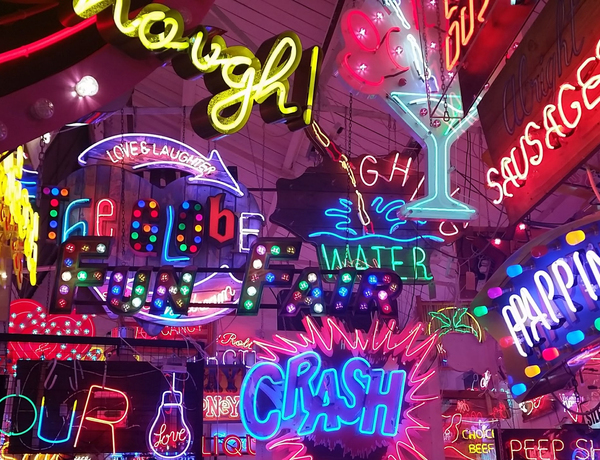
At the end of the Victoria line at the Walthomstow station, and then a 15 minute walk through some suburban streets with some lefts and at other times rights is an industrial estate. Through the gate and buried at the very end of the units where you are convinced you are lost and doubting it's existence at all is God's Own Junkyard. It's a worthy pilgrimage and actually sort of where you expect God would put a junkyard.
The warehouse is a monument to neon and the life works of the late Mr Neon, Chris Bracey. It's littered to the rooftop with cables, plug sockets and choice words with neon epigrams, the whole collection is stacked, I suppose how a junkyard of the sort would be. Full of sex, religion, americana, sci-fi and nostalgia that all blend together surprisingly well, It's a visual feast that you can take in with a coffee and an open mouth. It is a gem of a place.
It is really great.
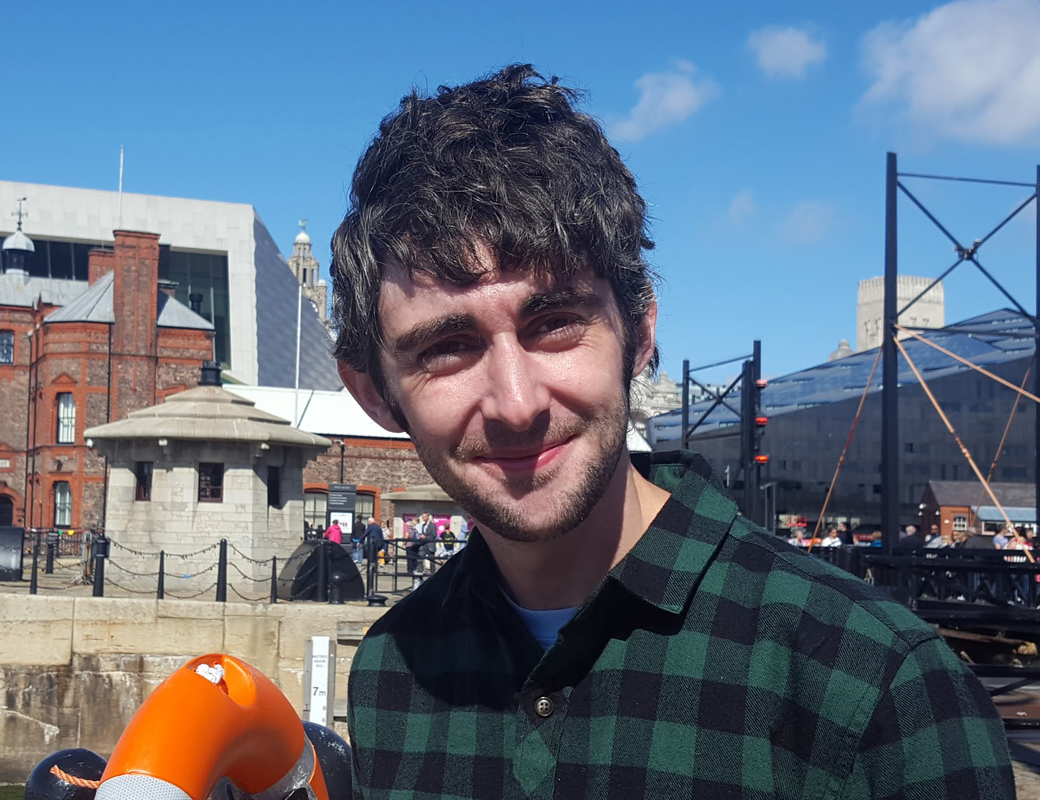
Adrian Westaway
Co-founder & Director of Technology and Magic at Special Projects
Adrian is an inventor, engineer and experience designer on a mission to make the human-technology interaction meaningful and delightful.
As co-founder of Special Projects he harnesses technology, inclusive research and magic thinking to devise design propositions that feel familiar yet wondrous.
A self-taught magician since the age of 11 and full member of the Magic Circle, he relentlessly pursues his conviction that “designers should use magic thinking and try to introduce surprise, delight and fuzzy feeling in the things they create.”
After becoming the first ever James Dyson Fellow in 2007, and a Fellow of the Royal Commission of 1851, in 2010, for his work on interactive lighting systems, Adrian built a playground in Peru, had whisky with Derren Brown as a student in Bristol, and tried to make his teachers disappear.
His contagious passion for magic and engineering made him a beloved tutor and lecturer in Design & Innovation at Queen Mary University and the Royal College of Art, in London and a visiting faculty member at the Copenhagen Institute of Interaction Design. There he teaches ‘Magic and Design’, a nomadic workshop where students are introduced to methods of using design and technology to create enchanted products and experiences.
Since an early stage, Giacomo felt interested in the visual perception of the volumes, light, transparencies, light materials, and how the eye treats the mind with a thoughtful use of them. Bachelor in Product Design and a Master’s degree in Architecture provided him all the technical aspects of the use of strengths, understanding of materials and 3D modelling.
Once has the technical knowledge and the convince of creating art, the material chose was the step to follow. The keenness of using a simple material whit shining properties became stronger thus after an examination of different materials the decision was to use brass and steel wire. In addition, the concept of using something cheap to create something precious is very attractive.
Creating a net of sewed wire with specific mental patrons and the using the strengths, making reinforcement to create shapes and curvatures lead final sculptures and models. The process followed during the last four years has been an autodidactic process of discovering how the weight, the tensions and the structure of the net can get transformed into an art piece.
Elizabeth Gabrielle Lee is an artist, researcher and writer. Her practice is guided by the iterations of slow violence and the dynamic between the ‘near’ and ‘elsewhere’. In attempting to disarm instruments of knowledge production, her practice shies away from reduction and completion. Steering away from essentialisms, she is interested in once-forgotten micro and muted narratives. By revisioning fractured traditions, she engages with visual and textual interventions to navigate the nuances of perception and retention.
Lee also runs XING, a research platform centered on the poetics and politics of Southeast and East Asian art practices. Assuming form of a shapeshifter, it morphs between localities and temporalities; with(in)flux. A domain of not-yet possibilities, the platform attempts to dismantle matrices concerned with the region from non-dominant perspectives.