Miltos Bottis is a Greek, London based graphic designer with a methodical approach to identities, printed matter, websites, and visual communication. Content-based research and typography-led design justify his approach to every project.
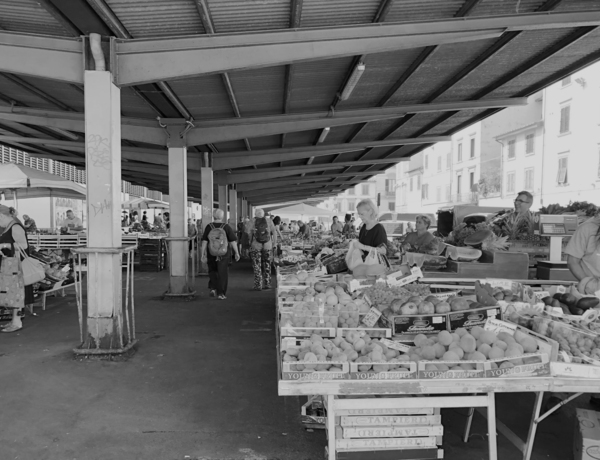
The market here is held every morning (excluding holidays) from 7:00 to 14:00, from Monday to saturday. It's where I shop weekly. It is partly outdoors, with stands of clothing, fruit and vegetables and food, and partly indoors, in the building built in 1873 by Giuseppe Mengoni. Inside the building you can find stalls of food, meat and fish, a couple of bakeries. While all the stalls inside are always the same- the ones on the outside (apart for the ones selling fruits and vegetables) tends to change everyday. Depending on the day you can find vintage clothing, shoes, vintage bags, military clothing, a florist, a stall that sells fabrics, an underwear stall and so on. The prices here are way much cheaper than the San Lorenzo market (the one close to the station) and the quality of the food is better.
If you're planning to stay in Florence for a while, grab a tote and do your grocery shopping here.
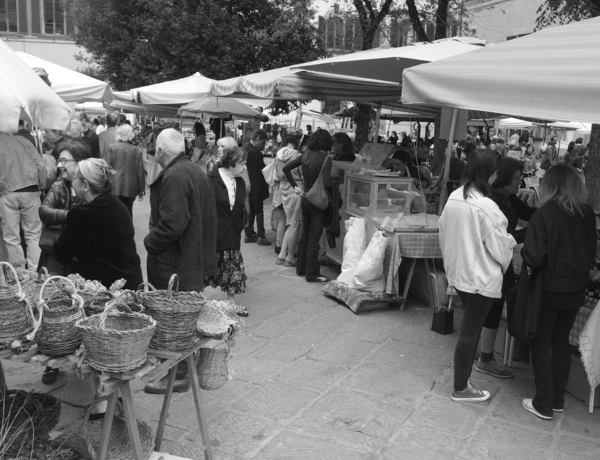
Santa Croce piazza is a cultural hub. This massive square hosts a variety of events from concerts (for all you George Michael fans) to German Christmas markets, in addition to it’s beautiful history-inside and out. To drop some names, venturing inside its ancient walls, one will find the tombs of Michelangelo, Galileo, Ghiberti and the false tomb of Dante. This photo depicts the annual German Christmas market where you can indulge in mulled wine, the best fucking sausages of your life, ornaments, and countless hand made crafts.
The Museum takes its name from its creator, one of the most famous Italian antiquarian of the late nineteenth century, who after years of intense commercial activity, decided to transform his collection into a museum and donate it to the City of Florence in 1922.
Stefano Bardini was a famous art dealer who collected objects of different periods and of high quality. Bardini contributed to spreading the myth of the Italian Renaissance throughout the world and showed great interest in all forms of art, which is one of the reasons to visit the collections: over 2000 pieces including sculptures, paintings, furniture pieces, ceramic pieces, tapestries and objects from ancient art to the eighteenth century. It's also possible to admire some fragments of the old centre of Florence, salvaged before destruction.
Inside the museum, everything is on display as it was at the time when Stefano Bardini worked as an antique dealer. The pieces are not grouped by historical period, but are put on display according to the taste of Bardini, so as to better accentuate the beauty of the pieces.
Even the building itself is remarkable for its use of doors, windows and the fact that many of the room are painted in a bright electric blue.
It doesn't usually appear in the guides (so it's not crowded) and you'll never find it on the MUST VISIT museum list, but it's worth a visit. The visit (depending on whether you are running or deciding to take it easy) takes approximately between 1h and 2:30.