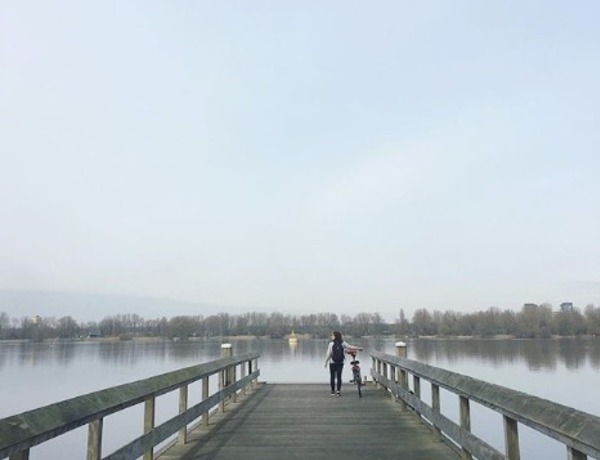
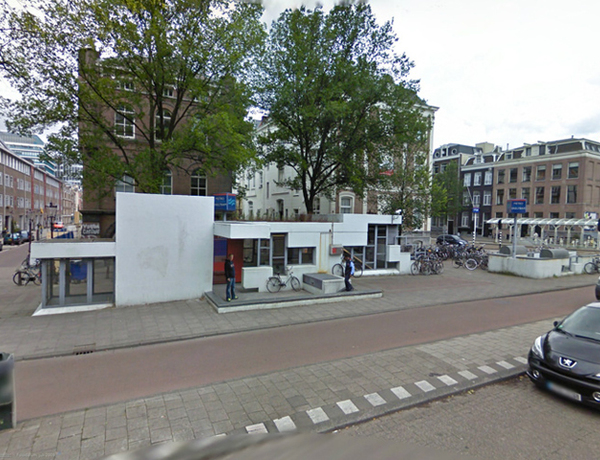
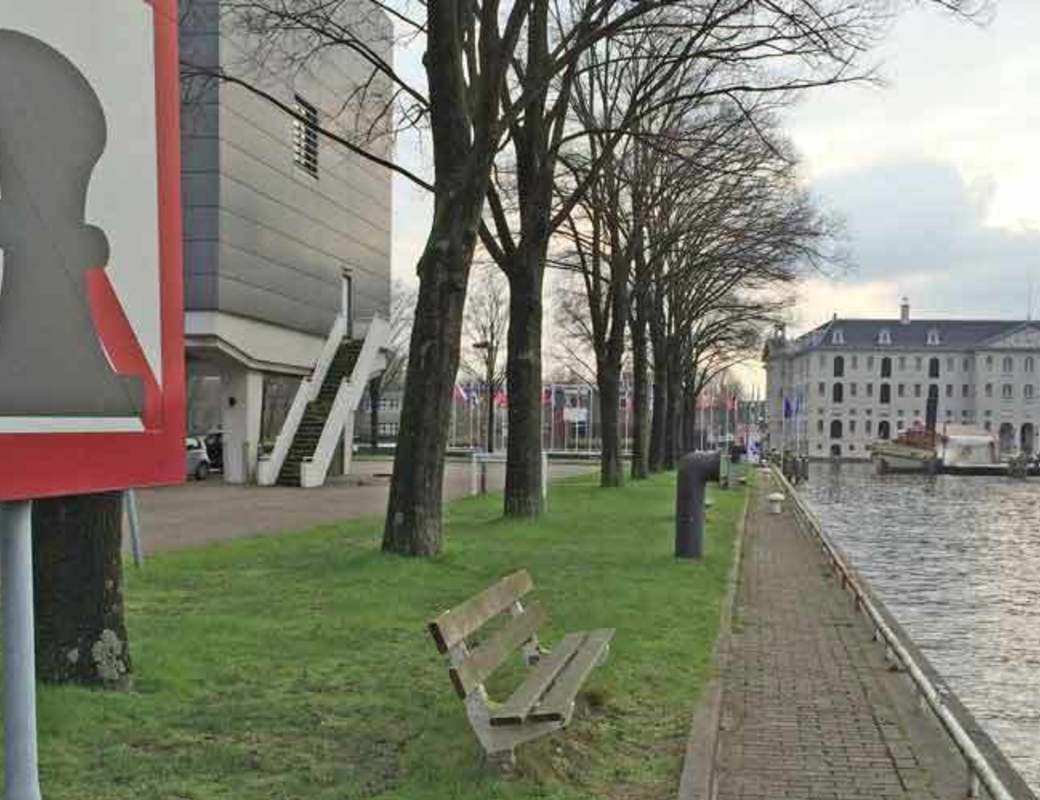
It is in the city centre. This former navy area is now partly open for the public. In summer you can swim in the canal there and have a great view on old Amsterdam, the Scheepvaartmuseum and the dead heart centre of Amsterdam. I like it most in winter, silent, grey, a place to mesmorize, walk alone around, meet a local who is walking his dog, than and have a coffee in pension Homeland, the restaurant hotel there. In central Amsterdam the space is rare, and what is there is overrun with tourists and full of local traffic, the trams, a million bikes, cars and pedestrians. That is why I like this place so much, super quiet space in the centre of Amsterdam.
Website
marineterrein.nl
Address
Marineterrein Amsterdam, 5 Kattenburgerstraat, Amsterdam, Netherlands
Current city: Amsterdam
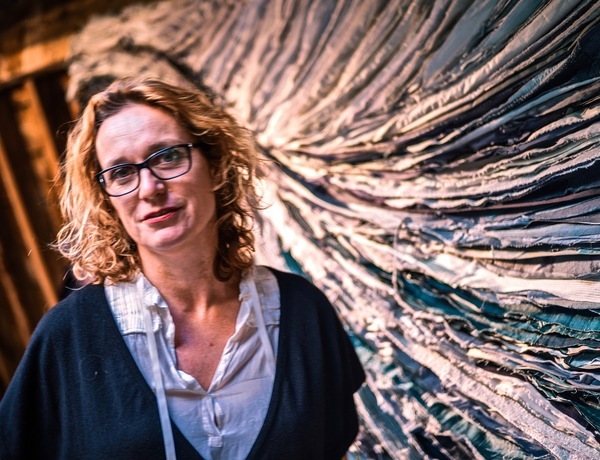
Waste Textiles Artist. Femke van Gemert, 1969 After a career in commercial fashion Femke decided to change the way to create things. Now she designs wall hangings and rugs that are unique, handmade and fully sustainable. By focussing on a single colour she re-uses textiles in abstract works. The beauty of imperfection and deterioration over time are always visible in her creations. The composition she creates radiates a certain mood or longing laden with fragments of the former characteristics of the used textile pieces. In the creation process Femke thinks about certain societal or environmental issues, these are reflected in the titles. In commissioned work clients can donate their own discarded textiles. This improves the personal involvement the owner has with the piece of art. This way Femke wants to revaluate textile waste that is omnipresent in our fast consuming society. The wall hangings improve acoustics and are suitable for homes, offices and public buildings. The love for textiles combined with the urge to explore the possibilities of discarded fabrics form a long lasting source of inspiration and a way to express opinions in Femke van Gemert’s life.
 

More Places in Amsterdam 100

Since I’m a graphic designer I'm obviously into books and my favourite bookstore in Amsterdam is Boekie Woekie. This small shop is located in the Nine Streets and they sell nice and special publications that are often hard to find because they are self published or published by small press publishers. If you are into graphic design you should really check it out.
Read More


Almost every underground station in Amsterdam has a fascinating story behind it. My favourite one is metro station ‘Weesperplein,’ because it has a hidden station underneath the actual station that was meant for the 'Singellijn.' However, that line was never build and the second station remained useless. Besides that the hidden station was also equipped to serve as a shelter during the cold war. The large doors that were meant to hermetically close the building are still visible at both ends of the platform. Other small details, like the panels in the ceiling than can be used as tables when turned around, are also silent references to the building’s former use. 

Read More
I've always been inspired by old industrial buildings like factories, but unfortunately such buildings have become rather rare in the Netherlands. At the moment you can still find some of the remains of the old harbour of Amsterdam called the ‘NDSM werf’ on the other side of the river ‘IJ,’ but this area seems to be in transition as well. For the time being the NDSM werf is a creative place where a lot of activities are taking place. The best part for me is the 'Y-helling' to enjoy the (modest) skyline of Amsterdam and to write graffiti.


Read More
Just a fantastic spot on the edge of the city. Its connection of the Amsterdam-Rijn Canal to the IJ, Amsterdam’s big open water, that was once part of the North Sea, but now dammed in by the Dutch. Sometimes it’s just a relief to leave the prettiness and the cuteness of the Amsterdam canals behind and experience some space. Few people come out here and in summertime it’s just a delightful spot to have a picnic and watch the boats come in.
Read More
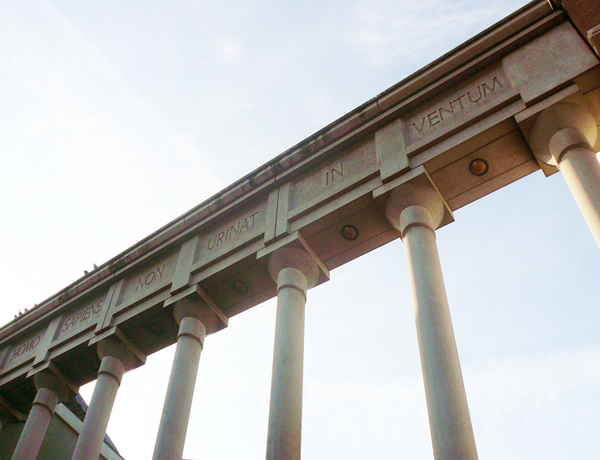
The portal between the Leidseplein nightlife area and the Max Eeuweplein is pompously accentuated by a classical looking façade, designed in 1991 by Zaanen Spanjers Architects. On the frieze, supported by columns, the architect has carved an inscription: ‘Homo sapiens non urinat in ventum’ - ‘A wise man does not piss into the wind’. A ‘wisecrack’, disguised in Latin.
Read More
Argentina
Austria
Bosnia and Herzegovina
Colombia
Croatia
Czechia
Ecuador
Finland
Georgia
Hong Kong
Iceland
Indonesia
Ireland
Israel
Latvia
Lithuania
Malta
Morocco
New Zealand
Oman
Pakistan
Panama
Philippines
Portugal
Puerto Rico
Romania
Serbia
Singapore
Slovenia
South Africa
South Korea
Sri Lanka
Taiwan
Thailand
Ukraine
United Arab Emirates
Uruguay