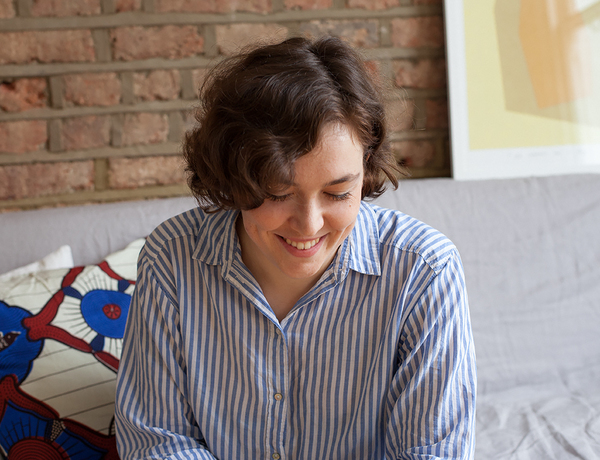
Mylène is a French art director, currently based in London. She’s currently art director for the books and gifts lists at Laurence King Publishing, part of Orion/Hachette UK.
Barbican, a residential estate in central London, is known for its brutalist architecture, almost a social experiment on how to live in an estate. I love walking around this area looking at the geometric shapes, the contrasting public spaces and the use of materials. The term brutalist originates from the fresh word for ‘raw’, and concrete is typically used as one of the main materials.The Barbican centre located in the centre is an arts centre and the largest of its kind in Europe, and was opened in 1982. The centre is used for classic and contemporary concerts, teatre, film screenings and art exhibitions, and houses a library, restaurants, cafes and bars. The areas’ architecture really invites you to go on a photo safari as there are great angles and light everywhere.
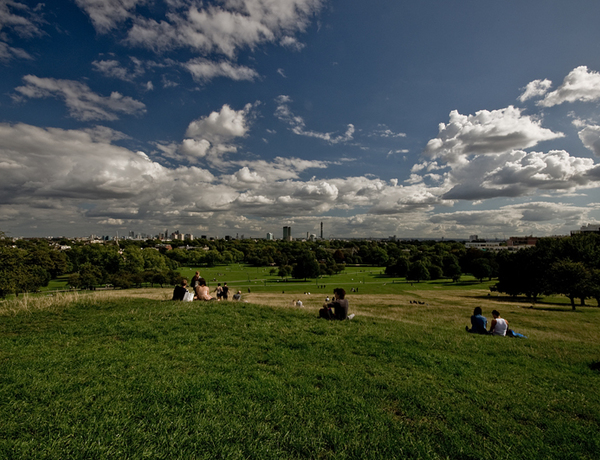
Warm summer nights should be spent in the high grass in Hampstead Heath above the ponds. For midsummer bring herring, snaps and songs and stay until sunrise!
The number 9 bus is the last of London’s old Routemasters. It’s a reminder of how far London has come over the years both in technology and design. The route itself is also one of the Heritage routes going past all of London’s key attractions such as Trafalgar Square, Piccadilly Circus, Hyde Park Corner and the Royal Albert Hall and the buses are still run by a traditional conductor which is fun and keeps things personal. It is a quintessential London journey.
Although freedom of speech is a human right in most civilised countries, Speakers’ Corner has been described as one of the few places in the world where anyone can just climb on a ‘soapbox’ and speak their minds on any subject as long as the police considers it lawful – and almost be guaranteed an audience.
It has been like this ever since this area of London’s Hyde Park was the site of Tyburn gallows, where public executions took place between 1196 and 1783, and the condemned were allowed to speak before being hanged.
Over the centuries, Speakers’ Corner has been the site of riots, demonstrations, public meetings of groups – such as the communists – that weren’t allowed to gather anywhere else, and was frequented by Marx, Lenin, George Orwell and many other historic figures.
While today it is mainly the scene of eccentrics, religious fanatics and oddballs of all kinds, several prominent speakers such as Heiko Khoo and Jonathan Fitter keep the tradition of meaningful discussions around political and social themes alive.
Religion has been debated in Hyde Park since the right to meet and speak freely was formally established in 1872. Today it’s the dominant topic by far, with religious speakers and preachers drawing the biggest crowds and clearly outnumbering the political meetings.
I have been documenting the people gathering here every Sunday since 2012.
Spring always arrives earlier to London, and London shows its most beautiful face during the spring. If you live in London, or if you come to visit, bring your training shoes and take a morning run along river Thames in Chiswick. Between Barnes Bridge and Hammersmith Bridge, there's a great trail on both sides of the river. And if you take the run in March, you might run through this wonderful Alice-in-Wonderland cherry-blossom landscape.