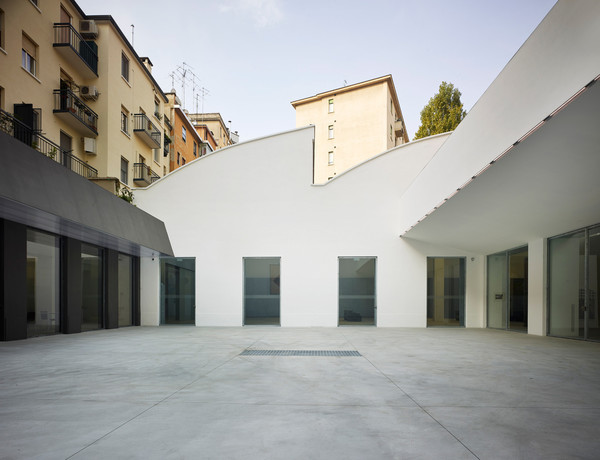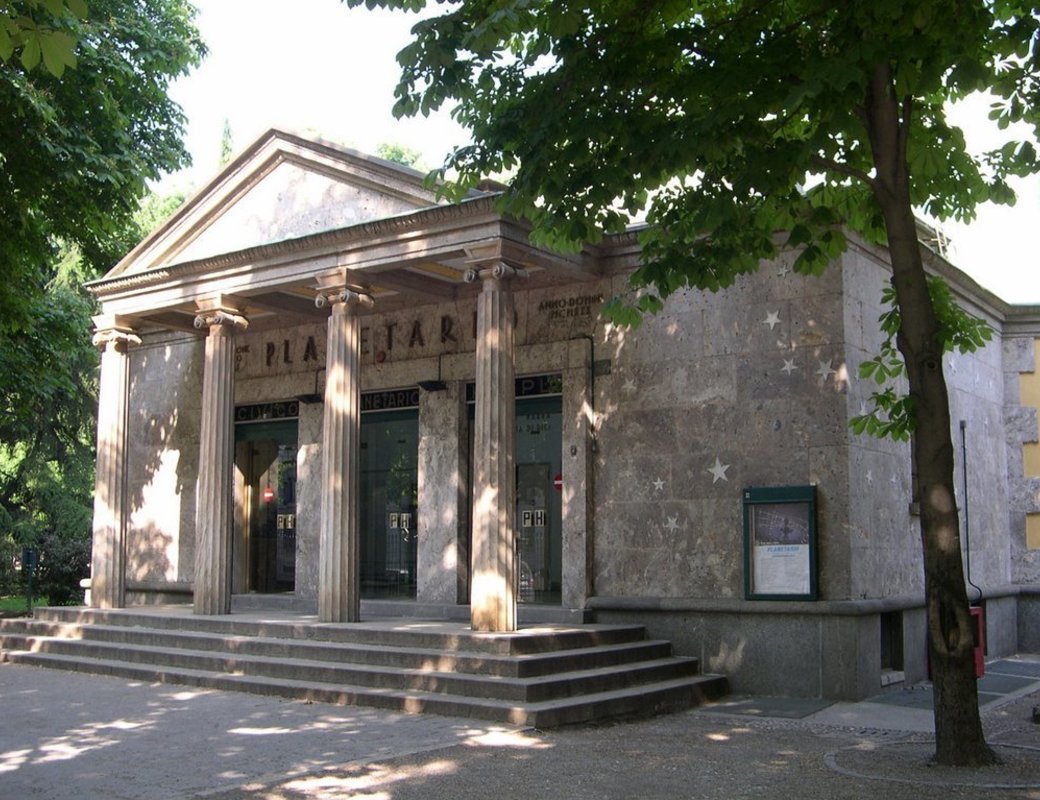
Vintage lovers! The Planetarium of Milan, Civico Planetario “Ulrico Hoepli”, is a building located at the entrance of Giardini di Porta Venezia. It’s a beautiful structure designed by Piero Portaluppi and commissioned by the Italian-Swiss publisher Ulrico Hoepli. Also the interior design is beautiful, there you can find a planetarium which projects and represents the image of the stars and their movements in the sky. The Planetarium also has a library which is a section of the Museum of Natural History, near by. They also organize educational activity concerning astronomy as talks, events and even concerts. 
Website
lofficina.eu
Address
Civico Planetario Ulrico Hoepli, 57 Corso Venezia, Milan, Italy
Current city: Milan
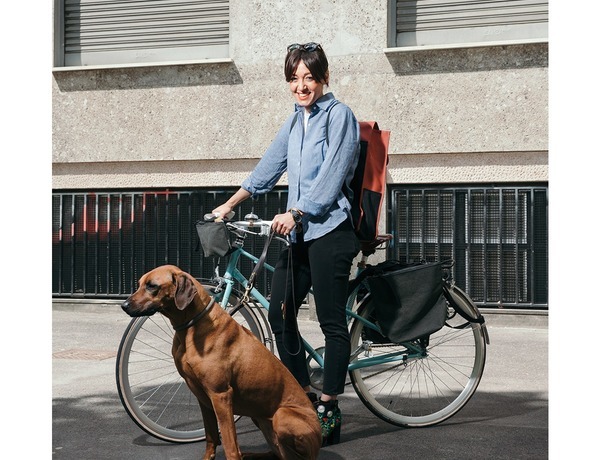
I am an independent Art Director, Visual Designer and Brand Strategist consultant based in Milan. I’m specialized in creation and management of brand identities, commissioned by direct clients as brands, companies and designers, and by design studios as well. Beyond that, I’m a true paper lover, literally obsessed with typography and always curious about what’s on in my city. And also when I travel, I always get in touch with local creative people. © pic by: Mattia Balsamini
 

More Places in Milan 60

Nilufar Depot: three storeys of historic and contemporary design, selected by Nina Yashar, one of Milan’s top design dealers. 
Read More
To really reach/understand a city you must live there or, at least, acting like you do. Nothing makes you feel more like a Milanese D.O.C. than stopping by Frida's on a Sunday morning to buy some flowers. Located in Brera this tiny shop has an extraordinary colour palette of flowers and plants. After that we just take a walk in the neighbourhood holding our bunch of Brassica Oleracea and our day is made.
Read More
Giacomo ristorante, bistrot... They are all located on the same street, Via Pasquale Sottocorno, but the rosticceria is the more, let's say, "easy-going" (and the cheapest) of the three. It's a good place for lunch and dinner - ask for a table at the "giardino interno".
Read More
The Brera Gallery was officially established in 1809, even though a first heterogeneous collection with educational purpose existed already from 1776 – and then increased in the following years – alongside the Accademia di Belle Arti, requested by Mary Therese of Austria to offer the students the opportunity to study lofty masterpieces of art close up. Brera become a museum to host the most important works of art from all of the areas conquered by the French armies. So unlike other important museums in Italy such as the Uffizi, Brera did not start out life as the private collection of a prince or nobleman but as the product of a deliberate policy decision. Paintings confiscated from churches and convents throughout Lombardy with the religious orders’ dissolution began to pour into the museum in the early years of the 19th century, soon to be joined by artworks of similar provenance from other areas of the Kingdom of Italy. This explains why the collection comprises chiefly religious works, many of them large altarpieces, and accounts for Brera’s special aura on which later acquisitions have had only a minor impact.
Read More
An architectural gem: immersed in an ample private garden with a swimming pool and a tennis court and set in the center of Milan, the Necchi Campiglio Villa was completed by the architect Piero Portaluppi in 1935. Commissioning the structure was the Necchi Campiglio family, part of the rich and elegant industrial middle class of Milan in the 1930s. The disposition of the interior spaces corresponds to the traditional layout of noble homes: the daytime areas on the ground floor, the bedrooms on the first floor, the service rooms in the areas under the roof, and the den as well as the changing rooms and the bathrooms for the pool in the basement. The Necchi Campiglio family wanted above all to distance themselves from the traditions of their day, and planned ample areas dedicated to the reception of guests and to the social whirl: the dining room, the smoking room, the library and the grand salon. Right after WWII, areas of the villa underwent changes effected by the architect Tomaso Buzzi, who sweetened the linearity of Portaluppi’s style, and inserted aspects inspired of the 18th century, especially those in the style of Louis the 15th of France.
Read More
Argentina
Austria
Bosnia and Herzegovina
Colombia
Croatia
Czechia
Ecuador
Finland
Georgia
Hong Kong
Iceland
Indonesia
Ireland
Israel
Latvia
Lithuania
Malta
Morocco
New Zealand
Oman
Pakistan
Panama
Philippines
Portugal
Puerto Rico
Romania
Serbia
Singapore
Slovenia
South Africa
South Korea
Sri Lanka
Taiwan
Thailand
Ukraine
United Arab Emirates
Uruguay