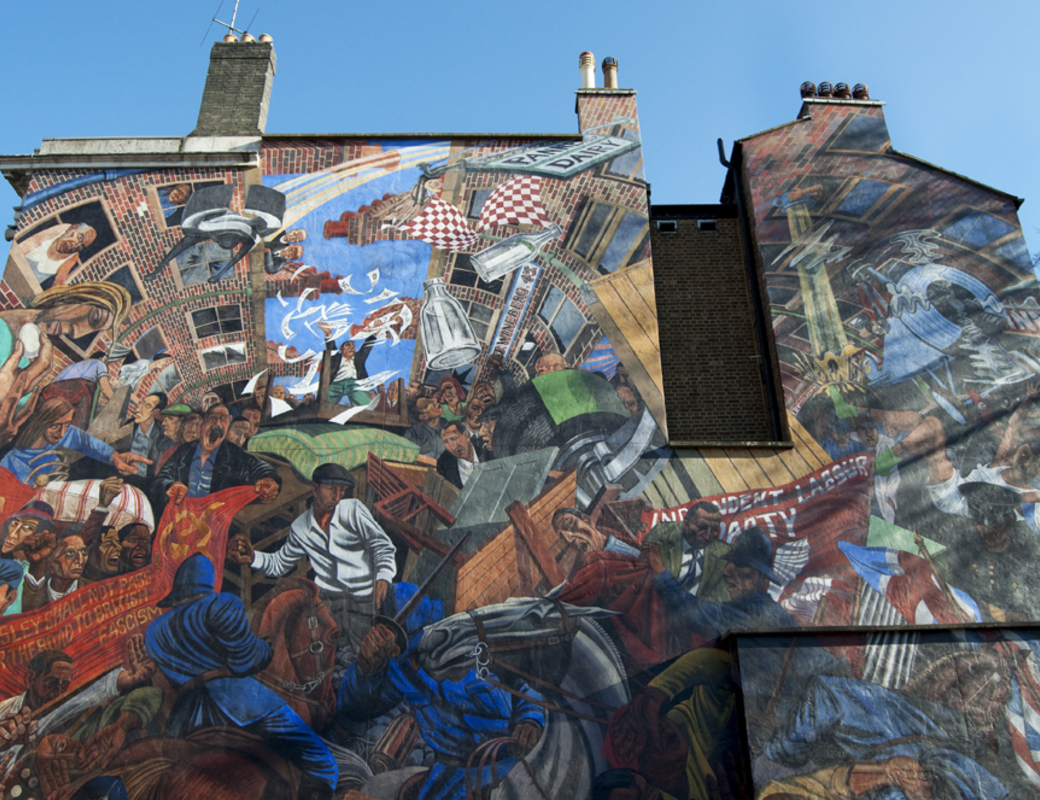
In 1936 Oswald Mosley’s British Union of Fascists attempted to march through East London in what was an attempt at an intimidating show of strength. Like today, this area was home to a large number of ethnic and religious minorities, particularly Jews. 300,000 people came out to oppose the march and blocked the route. The battle that followed was actually between the protesters and the police who tried to clear the route so that the march could take place. Seeing that they faced a losing battle and possibly a riot Mosley called off the march. The artist Dave Binnington began this mural in 1976 to commemorate that day, and it was eventually finished in 1982. The mural and the battle of Cable Street are both perfect examples of Britain at its very best.
Address
The Battle Of Cable Street Mural, St George's Town Hall, 236 Cable St, London, United Kingdom
Current city: London
Born and raised in Cardiff, James Davies is a photographer who has lived in London for 13 years. His work centres around the impact of the city upon its citizens and its citizens upon the city, as well as the wider social, economic and political themes that affect daily life in Britain. His most recent series, The Sclerosis of Existence, looks to explore the relationship between the people and the places of a city when seen through the repetition of daily routine.
 

More Places in London 471

Lovely space in Southbank. Interesting events and exhibitions. I really like the surroundings as well, especially during sunny days. Walk around and then have a rest drinking facing the river.
Read More
A contemporary café, great for breakfast, lunch and afternoon tea, on the top floor of Dover Street Market, just of Picadilly Circus.
Read More
I grew up in Brighton which is full of cheesy bars like this. If you can handle being surrounded by multiple screens playing Kylie at full volume, its pretty much the cheapest bar in central london. The cliental is so varied its great for people watching and completely un pretentious.
Read More
Award-winning restaurant and creative hub. Introducing great chefs from a variety of countries and cuisines.
Read More
Although freedom of speech is a human right in most civilised countries, Speakers’ Corner has been described as one of the few places in the world where anyone can just climb on a ‘soapbox’ and speak their minds on any subject as long as the police considers it lawful – and almost be guaranteed an audience. It has been like this ever since this area of London’s Hyde Park was the site of Tyburn gallows, where public executions took place between 1196 and 1783, and the condemned were allowed to speak before being hanged. Over the centuries, Speakers’ Corner has been the site of riots, demonstrations, public meetings of groups – such as the communists – that weren’t allowed to gather anywhere else, and was frequented by Marx, Lenin, George Orwell and many other historic figures.  While today it is mainly the scene of eccentrics, religious fanatics and oddballs of all kinds, several prominent speakers such as Heiko Khoo and Jonathan Fitter keep the tradition of meaningful discussions around political and social themes alive. Religion has been debated in Hyde Park since the right to meet and speak freely was formally established in 1872. Today it’s the dominant topic by far, with religious speakers and preachers drawing the biggest crowds and clearly outnumbering the political meetings.  I have been documenting the people gathering here every Sunday since 2012.
Read More
Argentina
Austria
Bosnia and Herzegovina
Colombia
Croatia
Czechia
Ecuador
Finland
Georgia
Hong Kong
Iceland
Indonesia
Ireland
Israel
Latvia
Lithuania
Malta
Morocco
New Zealand
Oman
Pakistan
Panama
Philippines
Portugal
Puerto Rico
Romania
Serbia
Singapore
Slovenia
South Africa
South Korea
Sri Lanka
Taiwan
Thailand
Ukraine
United Arab Emirates
Uruguay