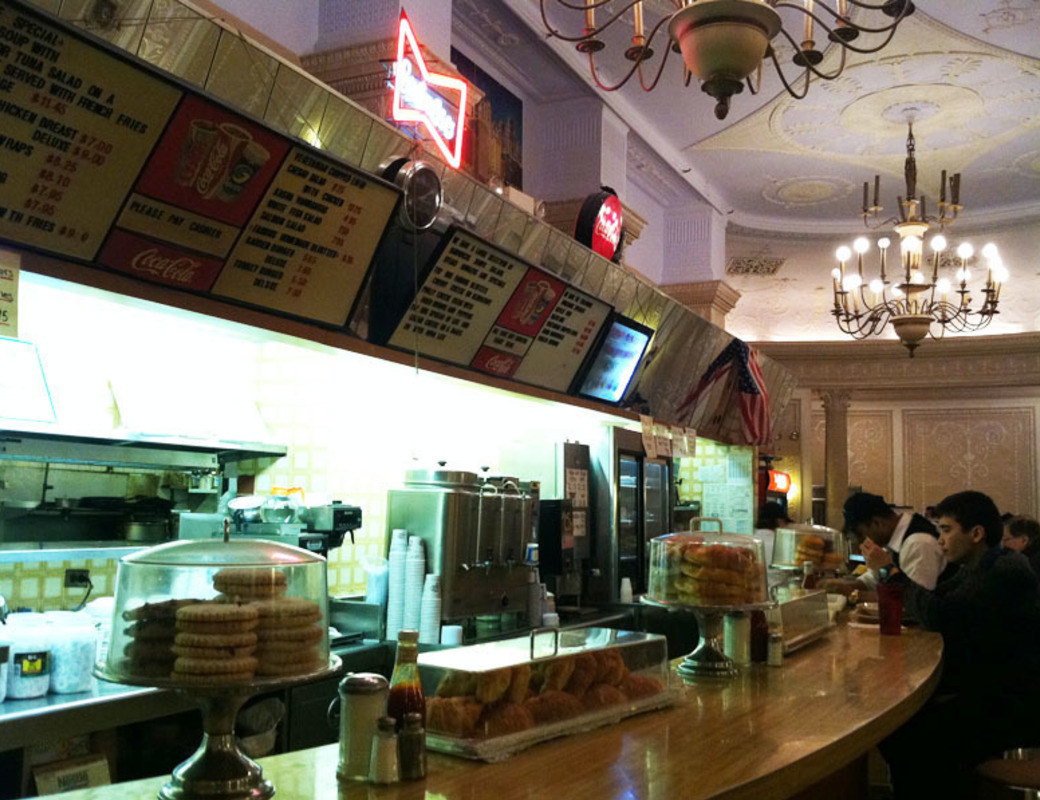
Nothing is more quintessentially New York than a diner. This eatery not only serves excellent, traditional diner fare, but does so in an eclectic environment that mixes Baroque decadence with Midtown grit.
Address
Cafe Edison, 228 West 47th Street, New York, United States
Current city: New York
Hilary Greenbaum is a New York-based graphic designer and design writer. Currently a staff designer and columnist at The New York Times Magazine, she studied design at the California Institute of the Arts (MFA 2006) and Carnegie Mellon University (BFA 2001). Her work has been recognized by the Society of Publication Designers, the Type Directors Club, the Art Directors Club, the AIGA, the Society for News Design and the Output Foundation.
 

More Places in New York 452

Great mid-eastern food in Chelsea/Flatiron/NoMad/whatever you call that area.
Read More
Neighborhood lunch place / Japanese supermarket. Love it for its authenticity and affordable Japanese food menu. Although its located in SOHO, it’s not hip, not fancy, not designed, not styled, not outstanding. Feels like a honest, family run business that makes the most out of this location for sure. Come here for Ramen, soba, sushi, and more. Try some fries with a choice of chili or wasabi mayonnaise. There’s something about them.
Read More
Summertime in Bushwick, means the locals will be barbecuing on the sidewalk, and playing in the hydrants. It's the perfect time to grab some shorts, and run down the street. If the one outside Mckibben isnt going off, one of the other 15 hydrants in the neighborhood will be.
Read More
I love sneaking over here in the middle of the day to see a movie - they always have the best selection of films. I recently saw Pina in 3D and The Kid with a Bike here, and another time I saw Bela Fleck play the banjo after a screening of Throw Down Your Heart.
Read More
In 1963, the Italian-born sculptor Costantino Nivola filled a playground that covers an entire city block with avant-garde abstractions. In the middle of an Upper Manhattan housing project, there are cuboid cutouts sculpted in cement, a fountain made with two diamond-shaped boulders, concrete play horses, and a sand-casted relief carved high into a wall. In the northeast corner, a matriarchal figure known as “The Nanny” rises from the ground. The artist’s sculptures were built in an era when urban development incorporated art in its effort to uplift communities and express democratic ideals. “A work designed for a public space is less a work of art than a civic act,” Nivola once said. “It concerns the ways in which we live together, and in which we influence each other.”
Read More
Argentina
Austria
Bosnia and Herzegovina
Colombia
Croatia
Czechia
Ecuador
Finland
Georgia
Hong Kong
Iceland
Indonesia
Ireland
Israel
Latvia
Lithuania
Malta
Morocco
New Zealand
Oman
Pakistan
Panama
Philippines
Portugal
Puerto Rico
Romania
Serbia
Singapore
Slovenia
South Africa
South Korea
Sri Lanka
Taiwan
Thailand
Ukraine
United Arab Emirates
Uruguay